Olivia Bouchard
passionate about health, social justice, education and the environment
(and art)
Senior Individualized Project:
From Loss to Growth and Prosperity
undergraduate thesis
We live within a dynamic, renewable and interconnected ecosystem, and yet, the relevance of biodiversity in our world is not obvious. Each individual member, from butterfly to human, plays a critical role. A small change -- like the loss of a species due to human impact -- can have an avalanche effect upon the rest of the system. The loss of biodiversity, through numerous, seemingly unimportant ecological changes, leads to major environmental consequences in the future.
Should we care?
The natural world selflessly provides us with abundant resources: pollination by butterflies and bees, and natural pest control by birds and bats enable the large-scale production of food and other raw materials. Some species are indicators of a healthy environment. The millions of trees on our planet convert our exhaled carbon dioxide into oxygen, an element all living things need for survival. And the list goes on.
Extinction of one species can occur naturally, or be accelerated due to the actions of humans. Either way, the consequences of losing a species can be dramatic. Species become extinct primarily due to the following three events: habitat destruction, introduction of non-native species and over-exploitation, with habitat fragmentation being the most widespread of the three. If we can prolong the lifespan of a species, we may be helping ourselves to live longer as well.
In order to preserve any species at risk of extinction, we must know and understand its natural history. Ask: how does the parent treat or behave around its offspring? Are certain aspects of its habitat necessary for its physiological survival?
There are a number of organizations in the Midwest and nationwide which are dedicated to preserving and conserving threatened or endangered species. Most of the time their attention focuses on the species’ habitat, improving or restoring the habitat to better support the species at risk. Whatever the necessary action, there are many supportive groups at work.
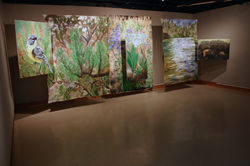
My work explores the reality of extinction and the role(s) humans play. Through painting, text and visual graphics my pieces will: illustrate the beauty of the species in relation to its habitat, consider the species’ aesthetic value, and explain why species are going extinct; leading to the connection between the natural world, beauty and humanity.
Finally, by providing factual information and offering the option for donations/suggestions for action, I present opportunities for my viewers to take action locally to reverse the trend toward extinction and instead preserve the interconnected global ecosystem of our natural world.

Walking Among Us
Acrylic: 30" x 40"
The Great Blue Heron thrives in a wetland habitat. Here, its natural resources are abundant and nesting locations are available. The heron is just one of many species that utilizes this space for its home. Many wetlands in Michigan and the greater Mid-West have been filled in or fragmented into smaller areas, causing the survival for the various animals depending on this environment to become quite challenging. The Great Blue Heron is no longer on the Endangered Species List; this is an example of a "success story" due to the powerful work the US Fish and Wildlife Service and other programs focused on species preservation.


Hanging On
Acrylic: 60" x 84" and 24” x 48”
Lycaeides melissa samuelis
Silver little life,
Pine barren; oak savanna,
On lupine I live.
The delicate and fragile beauty of this tiny creature articulates how simple it would be to hurt it. A small (about the size of a dime) and quite rare species, the Karner blue butterfly, is on the verge of extinction.
History
As a small yet significant member of our ecosystem, the butterfly is a pollinator and indicator of healthy environments. An important element in the food chain for birds, bats and other insectivorous animals, the loss of this staple species can have damaging effects on these animals.
Identified in 1944 in Karner, NY, the Karner blue butterfly lives a symbiotic life with the wild lupine flower. The larvae of the Karner blue feeds only on the leaves of the lupine in the northern bands of the lupine’s range; without it the butterfly cannot survive.
Problem
The Karner blue was Federally listed as an endangered species in 1992. Much of the Karner blue’s natural habitat has been fragmented or completely destroyed due to urbanization. With scarce wildlife preserves in its breeding ground and a decrease in natural habitat, there are fewer locations for the butterfly to lay its eggs. The Karner blue is a rare species, therefore collectors of butterflies find it desirable -- another cause to its decreasing population.
Solution
How can you help? The Xerces Society for Invertebrate Conservation focuses on the survival and prosperity of invertebrate species, like the Karner blue. The Toledo Zoo is working on breeding Karner blues to increase their numbers. Any donation to a conservation organization can help to regrow this butterfly’s natural habitat. On a broader scale, planting native flowers in your lawn and garden can help to preserve the biodiversity of insects in your area.


I’m Helping You
Acrylic: 30” x 40” and 60" x 72"
Setophaga kirtlandii
Delicate, yellow
Listen to the song I sing
I can help you, too.
Birds function as natural pesticides; by consuming insects that could potentially damage crops, these eaters reduce the need for chemical treatment of crops. The Kirtland’s warbler is on the verge of extinction. Being endangered due to habitat loss, its population numbers are quickly decreasing.
History
Many birds serve as natural pesticides, consuming insects that may eat crops and vegetation. Without birds and other insectivorous species, farmers and food producers are forced to use chemical pesticides on their crops to repel the attacks of bad bugs.
The Kirtland’s warbler was identified in 1851 by Dr. Jared Kirtland in Cleveland, OH, but now is only located in northern (lower) Michigan. Warblers require at least eight acres of dense young jack pine forest to nest and thrive.
Problem
The Kirtland’s warbler was Federally listed as endangered in 1967. The lack of young jack pine is a major reason for its population loss. Pine forests have been destroyed for the development of homes and roads, fragmenting the habitat and making it harder for the warblers to reproduce and for the young to mature.
The warbler is also at risk due to the parasitic activity of the brown-headed cowbird. Cowbirds lay their eggs in another bird’s nest; the eggs hatch and kick the warbler chicks out of the nest! Therefore survival of warbler offspring is severely affected.
Solution
How can you help? The Michigan Audubon Society is driven to conservation work for many bird species in Michigan. Through attending a Warbler Tour, you can put your money into a program that is effective and knowledgeable about warbler preservation. On a larger scale, setting aside land for a forest preserve that includes a vast nesting habitat (young jack pine) is a major way that the Kirtland’s warbler can begin to regain its numbers. Also, eradicating the cowbird, removing a truly aggressive and detrimental pest can help the warbler to bounce back.


Unseen But Not Unknown
Acrylic: 60" x 72" and 24” X 36”
Cryptobranchus alleganiensis bishopi
Large, shy, and harmless
Nocturnal, breathe through my skin
Fresh, clear water, please.
The Ozark hellbender is a species of salamander that lives solely in Missouri and Arkansas. This animal can reach up to 2 ½ feet long and lives a long life, sometimes up to 30 years old. It feeds primarily on crayfish and greatly enjoys living in cool, fast-flowing streams and rivers. Breathing through its skin, the hellbender requires clean fresh water for its respiration and intake of oxygen. Local gravel mining and dam production have depleted the amount of fresh clean water for this species, leading to habitat contamination and survival difficulties.
History
Although amphibians are species that can live on both land and water, the Ozark hellbender is strictly aquatic. The layered fleshy folds in its skin increase its capacity to respire through the water. Its ability to navigate in fast-flowing streams is due to its flat wide body. The adult hellbender is nocturnal, hiding under large flat rocks during the day, and feeds on crayfish at night.
Found only in Arkansas and Missouri, the Ozark hellbender was first identified in 1803 by French zoologist, Francois Daudin. Its name is perhaps derived from early settlers who claimed it was a “creature from hell, and bent on returning.” Its common names are the snot otter, devil dog, or mud-devil -- all being quite misleading because the hellbender is a shy harmless being.
Problem
The Ozark hellbender was listed as endangered in 2011, due to significantly depleted populations, primarily as a result of habitat loss. Dam construction, ore and gravel mining, and toxic runoff have degraded the hellbender’s clear fresh water systems. (Even minor alterations to a stream habitat can have drastic negative effects on the species living in them.) In addition, people using rivers for recreation have disrupted the large flat rocks in which the hellbenders hide. Lastly, similar to the Karner blue, because the Ozark hellbender is a rare species, it is a desired animal for the exotic pet market and trade.
Solution
How can you help? The Saint Louis Zoo is working on hellbender conservation at their Ron Goellner Center; a donation here can make a difference. One action is to become a local Stream Monitor (Kalamazoo) and help to clean up a water system. If you are someone who uses rivers for recreation, be conscientious of the habitat and wildlife you are enjoying. Lastly in a broader scale, refrain from polluting the stream or river, and land nearby, with pesticides or household toxic wastes.


A Broader Lens
Acrylic: 30” x 40” and Print
Identifying additional environmental global issues, aside form biodiversity loss, is an important step to becoming educated about our comprehensive ecosystem. The downstream effect of the loss of a species, like the Kirtland Warbler, can lead to poor food production in Michigan. If there are fewer birds to eat the bugs -- there will be more bugs to eat our crops.
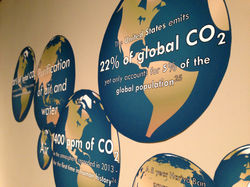
Conservation of our world may seem incomprehensible and overwhelming. Knowing the facts can allow for a greater understanding of the issues at hand. A global environmental issue is climate change. The reality of extinction holds true to the reality of a changing, warming climate and its consequences are very real.
Progress has been made to conserve and preserve our natural world. Some species’ numbers have increased, but countless are still disappearing. By acknowledging changes in our world, sharing information and feelings, and taking action to create change – we can be the solution.
Exhibition Documentation
 |  |  |  |
|---|---|---|---|
 |  |  |  |
 |